
How Businesses Can Cut Hosting Costs


Recently, more and more companies have been considering how to reduce data hosting expenses and optimize their IT infrastructure. The high costs of cloud services from giants like AWS, Microsoft Azure, and Google Cloud are forcing businesses to reassess their traditional solutions.
What only recently seemed like the only right choice—“everything to the cloud”—is now being reevaluated in terms of financial feasibility.
What’s particularly telling is that even large, globally recognized companies are deciding to move away from fully cloud-based data hosting. Recently, Basecamp—a company specializing in project management and team collaboration tools—publicly announced their decision to partially transition their infrastructure to owned servers. According to their estimates, this shift could save them over $2 million annually.
Why Cloud Services Are No Longer the Only Option

Cloud technologies are undoubtedly convenient: scalability, access from anywhere in the world, and no need to worry about physical infrastructure. But all these advantages come at a price—and sometimes, a steep one.
Today, cloud service expenses for many companies have grown into a full-scale budget item. And often, these are not investments in growth and development, but merely costs to maintain existing operations.
As Basecamp co-founder David Heinemeier Hansson noted:
“The cloud can be a good choice in certain situations, but the industry has skillfully convinced everyone it’s the only way. No wonder there’s cloud marketing everywhere—it’s incredibly profitable to make people believe owning your own hardware is impossible, or that managing Linux servers is too complicated!”
Companies are beginning to realize that paying for convenience and scalability is justified only where truly necessary. Everything else can be migrated to owned or leased dedicated servers—and expenses can be drastically reduced.
A Real Case: How Basecamp Saves Millions
Basecamp is a well-known American company that develops tools for project and team management. They've been operating in IT since 1999, with thousands of teams worldwide relying on their services.
For over a decade, Basecamp’s entire infrastructure was hosted on AWS. The company was paying around $1.5 million annually just for data storage on S3.
And now — amid rising costs — even they have decided to move away from cloud hosting in favor of their own infrastructure.
“This summer, we’re deleting our AWS account. We’re saying goodbye to the $1.5 million annual S3 storage bill,” — wrote the company’s CTO.
Basecamp invested $1.5 million into their own servers and relocated 18 petabytes of data into their private data centers. After the migration, their storage costs are expected to drop to under $200,000 per year.
Annual savings: over $1.2 million. The team remained the same—the only change was the management model.
If even a company like Basecamp no longer sees the value in overpaying for cloud services—maybe it’s time to reassess your own infrastructure costs?
How Hybrid Infrastructure Works
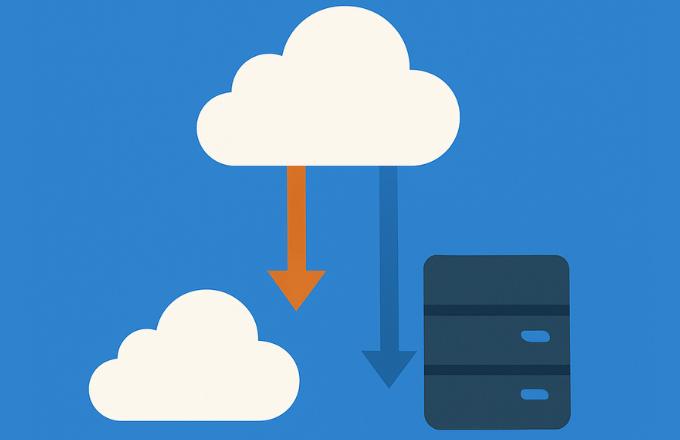
It’s important to understand: this isn’t about abandoning cloud solutions altogether. The key is to use them where they’re truly justified, while placing the rest on more cost-effective dedicated servers. This approach is called hybrid infrastructure, and today it represents the optimal balance between cost and performance.
What does this look like in practice?
What makes sense to keep in the cloud:
- High-load services where scalability is critical
- Features that require specialized cloud technologies (e.g., complex analytics or machine learning)
- Processes with unstable or seasonal traffic loads, where pay-as-you-go cloud pricing is more economical
What can be effectively hosted on dedicated servers:
- Large volumes of data (archives, backups, media files)
- Internal services and tools that don’t require constant scalability
- Stable business processes with predictable workloads
The result of this approach is nearly the same level of functionality as a fully cloud-based setup—but with far more predictable and significantly reduced expenses.
A Real Host4Biz Example: 6x Cost Reduction

A client approached us with a similar challenge: their web project’s static files — around 30 TB—were hosted in the cloud, with monthly growth of about 600 GB. Over time, the costs of storing and serving this data became unmanageable.
We offered a tailored solution:
- We allocated space for the client within our fault-tolerant Ceph storage cluster. It’s practically infinitely scalable—this client now uses 70 TB.
- We set up a separate server for working with hot and cold static data and helped connect it to the cluster via network-attached storage.
The result for the client? Infrastructure costs dropped by 6 times! At the same time, the quality and reliability of service remained high, while financial pressure was significantly reduced.
Ready to Discuss How You Can Save?
As your project grows, so do infrastructure costs. But that doesn’t mean you have to settle for high hosting bills. Sometimes, it’s enough to simply reevaluate your approach—and you’ll see how much more efficiently you can allocate resources and optimize spending.
At Host4Biz, we help companies find exactly these kinds of solutions. Every project is approached individually. Together with you, we’ll calculate which parts of your infrastructure should stay in the cloud and which can be safely and cost-effectively moved to dedicated servers.
Want to find out how much you could save? Write to us and we’ll propose the optimal infrastructure setup for your business.

